Chinese


2026 New 6-S Fiberglass Shaking Table for Tungsten Ore: Price, Specs & Case Study
If you are in the tungsten ore processing business, you know the struggle: fine-grained tungsten is tough to recover. You might lose 30-40% of your valuable tin or tungsten if your gravity method is not sharp enough.
Today, we're talking about a piece of equipment that changes that narrative. The 2026 New 6-S Fiberglass Shaking Table from Jiangxi Hengchang Mining Machinery.
This isn't just a "bigger and stronger" upgrade. It's a precision tool designed to maximize recovery of fine tungsten, especially scheelite and wolframite. In this post, we break down the price, specs, and a real-world case study. No fluff, just hard data.
What is a 6-S Shaking Table?
Simply put, a shaking table is a gravity separation device. It uses a combination of vibration, water flow, and the specific gravity of minerals to separate heavy particles (like tungsten) from lighter waste rock (gangue).
The 6-S is a specific model – it's not a generic term. It refers to a standard, robust design used globally. The Fiberglass version? That's the upgrade. Traditional tables were made of wood with rubber liners. Fiberglass is lighter, more durable, and won't rot. For tungsten, this matters because you need consistent performance without downtime.
Global Success Stories: Where This Table Works
This isn't a theory. Here's where the 6-S fiberglass table is making money for operators:
China (Jiangxi Province): A medium-scale tungsten mine replaced old spiral classifiers with 3 banks of 6-S tables. Recovery of fine scheelite (under 100 mesh) jumped from 48% to 72%.Vietnam: A tin-tungsten tailings retreatment plant uses a single 6-S table to scavenge residual wolframite from old sand. They produce a 60% WO3 concentrate from feed grading only 0.3%.
Myanmar: A small private miner uses a 6-S table for manual sorting. They process 1 ton per shift, but the grade consistency is exceptional.
These aren't billion-dollar operations. They are typical of the mid-tier mines we serve. The common factor? They needed to squeeze every gram of tungsten out of their material.
How It Works: The "Gravity + Motion" Principle
Let's keep it simple.
Feed: You pump a slurry (water + crushed ore) onto the table's surface.Vibration: The tablehead shakes the deck back and forth rapidly (about 280-320 strokes per minute). This movement "throws" particles forward.
Water Wash: A stream of water flows across the deck from the side.
Separation: Heavy tungsten particles sink to the deck surface. They are carried by the vibration to the concentrate end (front-right). Light gangue (quartz, clay) stays on top of the water film. The cross-flow water pushes it to the tailings side (left).
Discharge: You get three products: Concentrate (tungsten), Middlings (lower grade, can be re-run), and Tailings (waste).
Crucial for Tungsten: Tungsten is very dense (7.2-7.5 SG). It responds perfectly to this sideways motion. You get a very clean cut.
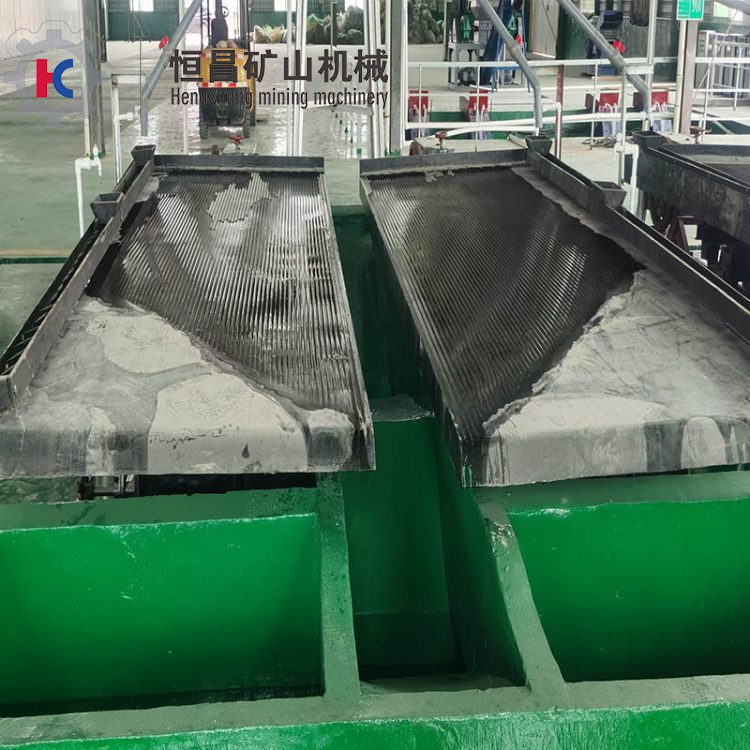
Structural Features: Why Fiberglass?
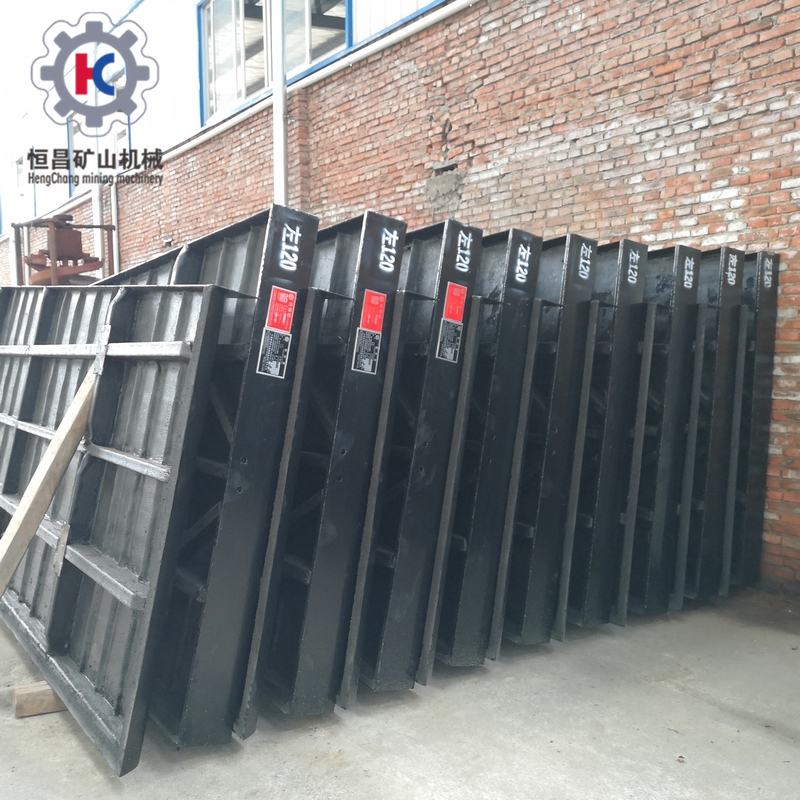
The deck is the heart. Here's why the 2026 fiberglass version from Jiangxi Hengchang stands out:
Lighter Weight: Fiberglass deck weighs about 50% less than a wood deck. Easier to move, mount, and less strain on the support frame.No Rot or Warping: Wood decks swell or rot in humid concentrators. Fiberglass is inert. It lasts 5-8 years without maintenance.
Smooth Surface: Less friction. Particles slide better. This means finer tungsten (down to 74 microns) can be recovered.
Easy Riffle Pattern: The fiberglass can be molded into a precise "plane-wave" riffle pattern. This is essential for fine tungsten. The riffles act as tiny dams, holding heavy particles.
Corrosion Resistant: Tungsten often coexists with sulfides (pyrite, arsenopyrite). These can oxidize and create acidic water. Fiberglass doesn't care.
What Ores Can This Table Process?
This model is a jack-of-all-trades, but it excels at specific materials:
| Ore Type | Suitability | Specific Notes |
|---|---|---|
| Tungsten (Scheelite/Wolframite) | Excellent | Best for fine-grained recovery (0.074-2mm). High grade concentrate. |
| Tin (Cassiterite) | Excellent | Same density range. Replaces jigs for fine tin. |
| Tantalum & Niobium | Good | Works well for fine-grained coltan. |
| Gold (Placer) | Good | Can recover fine gold, but a shaker is slower than a sluice. Use for clean-up. |
| Iron (Hematite) | Fair | Only if the hematite is very pure and fine. Usually, magnetic separation is better. |
| Coal | Good | Can clean coal by removing rock. Opposite of metal separation. |
For Tungsten: This is your primary clean-up tool. It takes the concentrate from your jig or spiral and turns it into a high-grade product that can go directly to a shaking table or magnetic separator.
Key Advantages for Tungsten Recovery
Why not a jig? Why not a spiral?
High Concentration Ratio: You can upgrade feed from 0.3% WO3 to 30% WO3 in a single pass if the liberation is good. A jig struggles with anything below 1% feed grade.Extremely Selective: The shaking table creates a "picket fence" effect. It doesn't just separate by density; it separates by shape too. Flat, fine tungsten grains stay on, while round quartz grains wash off.
Handles Slimes: While not a slime table (the 6-S is for sand), it handles a significant amount of -200 mesh material better than a jig or spiral.
No Power Hungry Process: Uses about 1.1kW motor. Very low operating cost.
Processing Capacity & Specifications (2026 Model)
Let's get into the hard numbers for the Jiangxi Hengchang 6-S Fiberglass Table:
| Parameter | Specification |
|---|---|
| Model | 6-S (Concentrating Table) |
| Deck Material | Fiberglass (FRP) |
| Deck Size (Length x Width) | 4500mm x 1850mm (standard) or 2100mm (wide version) |
| Feed Size | 0.074mm - 2mm (for tungsten) |
| Capacity | 0.5 - 1.8 tons per hour (dry weight basis) |
| Stroke (mm) | 8 - 36mm (adjustable) |
| Stroke Frequency | 240 - 360 strokes/min |
| Lateral Slope (Splash Angle) | 0 - 10 degrees (adjustable) |
| Motor Power | 1.1 kW (1.5 HP) |
| Weight | Approx. 1100 kg (fiberglass deck, modern frame) |
| Warranty | 12 months (Jiangxi Hengchang standard) |
Note: The "2026" designation by Jiangxi Hengchang refers to a refined, optimized gearbox and bearing housing design from the factory. This reduces noise and wear compared to older standard versions.
Daily Operation & Maintenance: The "Do's and Don'ts"
If you ignore this, your recovery will crash. Here's the real-world checklist:
DO:
Check Water Quality: Muddy water kills the gravity separation. Use clean process water (clear cyclone overflow works).Adjust Stroke Length First: The stroke length determines the "throw" of your tungsten. For fine tungsten, use short strokes (12-15mm). For coarse tungsten (0.5mm+), use medium strokes (20-24mm).
Monitor the Slurry Density: Target 20-30% solids by weight. If it's too thick, the table bed shorts out. If too thin, you wash away your tungsten.
Grease the Gearbox: Every 8 hours. Use lithium grease. The peak load is on the eccentric mechanism.
DON'T:
Don't Skimp on the Riffle Pattern: You cannot use a standard "heavy sand" pattern for tungsten. You need a fine sand or slime pattern with short, shallow riffles. (Hengchang ships it with the correct pattern for your specific ore).Don't Overload: Trying to process 2 tons per hour on a table rated for 1 ton only wastes time. You'll just get medium-grade concentrate.
Don't Let the Table Sit Idle: If you stop the feed, keep the water running for 2-3 minutes. Let the deck wash itself clean. Otherwise, heavy particles will dry and stick to the fiberglass.
Comparison: 6-S Table vs. Other Gravity Equipment
How does it stack up against the competition?
| Feature | 6-S Shaking Table | Spiral Classifier | Jig (Diaphragm/Denver) | Magnetic Separator (Wet High Intensity) |
|---|---|---|---|---|
| Application | Fine tungsten (0.074-2mm) | Coarse tungsten (1-10mm) | Coarse tungsten (2-10mm) | Removing magnetic gangue (iron) from tungsten. |
| Recovery of Fines | Very High (85-95%) | Low (40-60%) | Low (50-70%) | N/A (Shape doesn't matter) |
| Capital Cost | $4,500 - $8,000 | $2,500 - $5,000 | $6,000 - $15,000 | $10,000 - $30,000 |
| Operating Cost | Low (Water + Motor) | Low (Motor) | Medium (Water + Motor + Liner wear) | High (Power + Coils + Matrix) |
| Selectivity | Excellent (Sharp cut) | Fair (Washes off fines) | Good (Can accept some middlings) | Fair (Only if magnetic difference exists) |
The Verdict: For a small-to-medium tungsten operation processing sand-size material (0.074-2mm), the 6-S table is the most efficient and most selective option. If you want to see a big jump in your gravity recovery, start with a shaking table.
The Case Study: A 5 TPD Tungsten Clean-Up Plant
Location: A remote mine in South China. Problem: The mine had a ball mill and a jig. The jig concentrate was 15-20% WO3. They wanted 45%+ WO3 to sell to a chemical plant. Solution: They bought two Jiangxi Hengchang 6-S Fiberglass Tables. Setup:
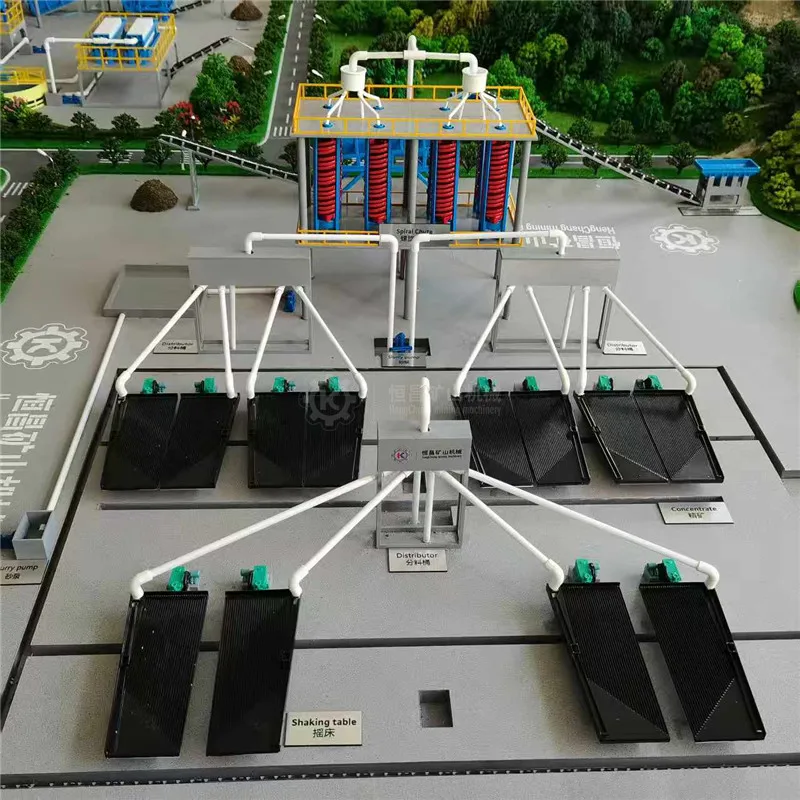
Jig concentrate (gravity fed) → Slurry pump → Desliming cyclone (removes -400 mesh slimes).Underflow (sand) → Table #1 (Primary cleaning): Produces 35% WO3 concentrate.
Middling from Table #1 → Table #2 (Recleaning): Produces 45% WO3 concentrate.
Tailings from both tables (0.2% WO3) sent to final tailings dam.
Results after 3 months:
Feed grade: 0.8% WO3 (from ball mill)Concentrate grade: 48.5% WO3
Overall recovery: 86% (This includes the jig + table circuit).
Cost per ton: $0.12 per ton of feed (water + power + labor).
Why did the fiberglass table work?
The fiberglass deck didn't warp in the humid environment.The fine-riffle pattern caught the -100 mesh (+150 micron) tungsten that the jig was missing.
The operator could see the separation line clearly and adjust the water flow.
How Much Does It Cost? (2026 Price Reference)
Prices fluctuate, but here is a realistic range for a new Jiangxi Hengchang 6-S Fiberglass Shaking Table in 2026:
Standard Model (4500 x 1850mm): $4,500 - $6,500 USD (FOB China port).Wide Model (4500 x 2100mm) with VFD: $6,800 - $8,500 USD (FOB China port).
What you get:
The fiberglass deck (with custom riffles for tungsten).The steel support frame (painted).
The drive mechanism (gearbox + motor + pulley).
1 set of spare parts (belts, seal rings).
12-month warranty on drive parts.
Pro Tip: Ask Jiangxi Hengchang for the "2026 Upgrade" package. This includes a sealed bearing housing and a stronger gearbox shaft. It adds about $200 to the price but saves you from replacing the gearbox after 2 years.
Application Scenarios: Where to Use This Table
You wouldn't put a 6-S table in a primary mill circuit (too slow). Here are the best spots:
Cleaner Circuit: After a jig or spiral. Takes the middlings and turns them into marketable concentrate.Scavenger Circuit: Processing old tailings piles. A single table can recover gold, tungsten, or tin from waste.
Pilot Plant: For testing a new deposit. A 6-S table is easy to set up. Process 200 kg of ore in a day and know your recovery.
Small-Scale Mining: Perfect for 5-10 TPD operations. You don't need a complex flotation cell for tungsten.
Final Word: Should You Buy One?
If you are processing tungsten ore in the range of 0.074mm to 1mm, the answer is almost certainly Yes.
The 2026 6-S Fiberglass Shaking Table from Jiangxi Hengchang solves the two biggest problems in fine tungsten recovery: low concentration ratio and poor fine-particle capture.
It's affordable.It's durable.
It's simple to operate (any laborer can learn in 2 days).
It gives you a clean, salable concentrate.
Don't buy a jig just because "that's what we always use." For fine tungsten, a shaking table is the standard.
Need a quote or the correct riffle pattern for your ore? Contact Jiangxi Hengchang Mining Machinery. They can custom-test your ore and give you the exact deck setup. That "test before you buy" service is worth its weight in tungsten.
— End of Article —