Chinese


Ball Mill or Wet Pan Mill? How to Choose the Right Grinder for Hard-Rock Gold Ore
Ball Mill or Wet Pan Mill? How to Choose the Right Grinder for Hard-Rock Gold Ore
Industry Insight – In the processing of hard-rock gold deposits, grinding is the gatekeeper of recovery. If gold-bearing minerals are not sufficiently liberated, even the best gravity concentrators or flotation circuits cannot capture what they cannot see. Two machines dominate small-to-mid-scale gold milling operations worldwide: the ball mill and the wet pan mill (also known as a wheel grinder or electric pan mill).
While both reduce rock to powder, they differ sharply in mechanism, cost profile, and ideal application. Choosing correctly can mean the difference between profitable liberation and expensive over-grinding.
Ball Mill: Precision Liberation at Scale
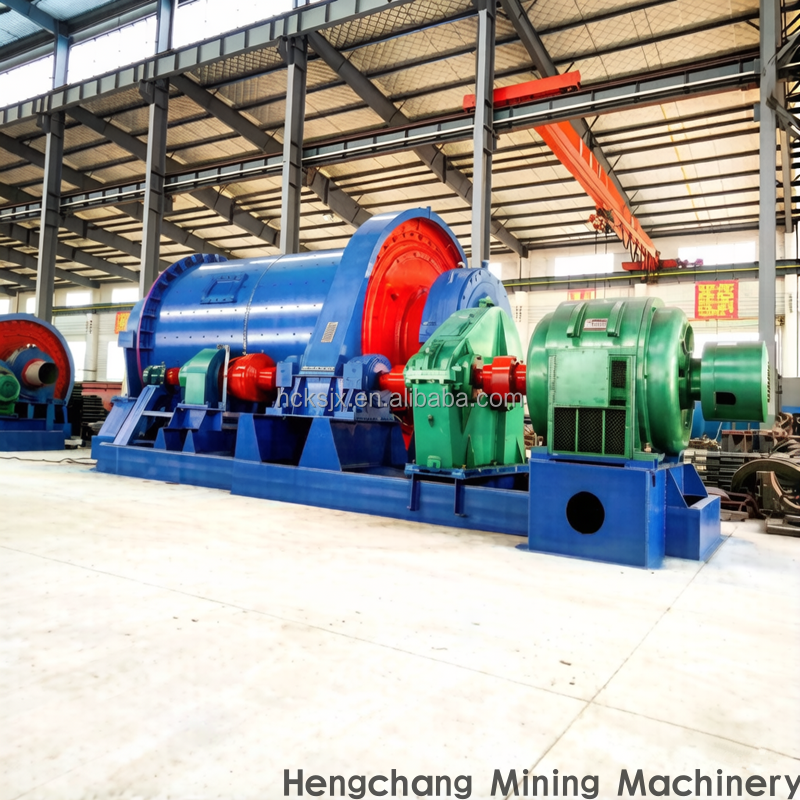
A ball mill uses rotating steel cylinders charged with forged steel balls. As the drum turns, the balls cascade and tumble, impacting and grinding ore particles against one another and the mill liners.
When paired with a spiral classifier or hydrocyclone in a closed circuit, the ball mill becomes a precision instrument:
- Operators can tightly control grind size (P80), ensuring optimal liberation of fine or complex gold associations.
- It handles a wide range of feed sizes and ore hardness profiles.
- The discharge is ideally suited for downstream processes such as gravity concentration (shaking tables, centrifugal concentrators) and flotation.
Best suited for:
- Medium- to high-tonnage operations.
- Ores where gold is finely disseminated or locked within sulfide minerals.
- Plants requiring consistent, adjustable product fineness.
Wet Pan Mill: Simplicity and Low-Capex Grinding
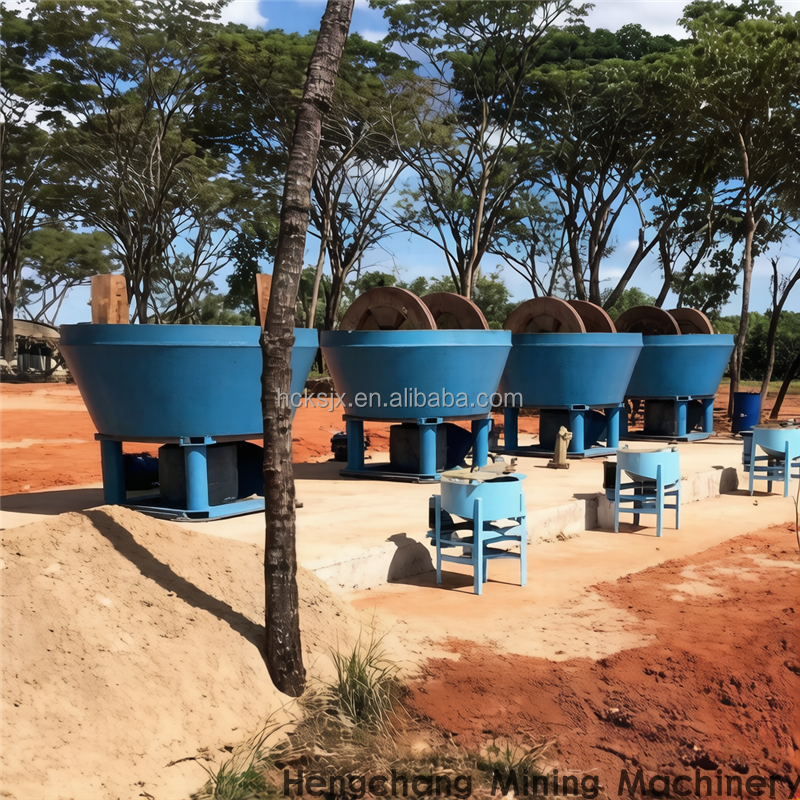
The wet pan mill takes a radically different approach. Instead of cascading media, it relies on the massive gravitational force of heavy grinding wheels (rollers) rotating on a horizontal grinding bed. Ore pulp is continuously fed into the pan, where the wheels crush and shear particles against the base plate.
Its appeal lies in operational simplicity:
- Minimal mechanical complexity and low initial capital investment.
- Direct recovery of free gold from the mill discharge using sluices or shaking tables.
- Lower energy consumption per tonne compared to small, inefficient ball mills.
Best suited for:
- Small-scale or artisanal hard-rock gold operations.
- Ores where gold occurs as coarse, liberated particles (free gold).
- Sites with limited access to skilled maintenance personnel or spare parts.
Head-to-Head Comparison
Feature | Ball Mill | Wet Pan Mill |
|---|---|---|
Grinding Mechanism | Impact & attrition (steel balls) | Compression & shear (grinding wheels) |
Product Fineness Control | High (via closed-circuit classification) | Moderate (manual/mechanical adjustment) |
Throughput | High (continuous, scalable) | Low to Medium (batch or semi-continuous) |
Capital Cost | Higher | Significantly Lower |
Operating Cost | Moderate to High (media, liners, power) | Low (minimal consumables) |
Ideal Ore Type | Fine-grained, refractory, or sulfide-rich gold ores | Coarse, free-milling gold ores |
Downstream Use | Gravity, Flotation, CIL/CIP | Primarily Gravity Separation |
Making the Choice
The decision ultimately hinges on three factors: ore mineralogy, production scale, and budget.
- Choose a ball mill if your gold is finely embedded in the rock matrix, if you need precise control over grind size for flotation or cyanidation, or if your target throughput exceeds several tonnes per hour.
- Opt for a wet pan mill if you are processing a small, free-milling deposit where coarse gold can be recovered by gravity alone, and your priority is minimizing upfront investment and operational complexity.
In many developing regions, wet pan mills serve as the entry point for hard-rock gold miners, offering a balance between recovery and affordability. Meanwhile, ball mills remain the backbone of commercial hard-rock gold plants where liberation efficiency directly dictates profitability.