Chinese


2026 How 6S Concentrating Table Outperforms Single Layer in Lithium Mica Processing
Introduction: Why You Should Care About the 6S Concentrating Table
If you're in the lithium mica processing game, you've probably heard about concentrating tables. But here's the thing—not all tables are created equal. The 6S concentrating table has become a game-changer in recent years for good reasons.
This isn't just another piece of equipment. For operations processing lithium mica, a critical mineral for the EV battery supply chain, the difference between a standard single-layer table and a 6S table can mean skipping from 60% recovery to 85%+.
Let's get into why the 6S is the boss in this niche.
What is a 6S Concentrating Table?
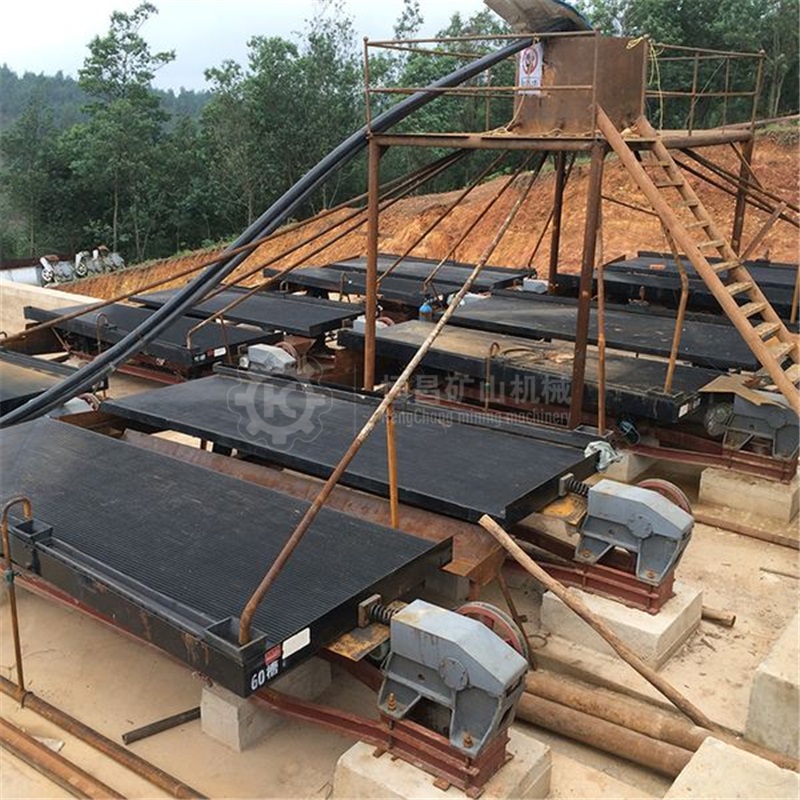
The 6S concentrating table is a heavy-duty gravity separator, designed for fine particle recovery. It's the upgraded version of your standard single-layer table, with more surface area, better deck riffle design, and stronger drive mechanisms.
Pro tip: The "6S" name comes from its model classification, not its size. These tables typically have a large trapezoidal deck, ranging from 4.5m to 6m in length, giving you significantly more working area than a single-layer table.
Real-World Success: Lithium Mica Cases from China and Beyond
Case 1: Jiangxi Province, China (2024)
A local lithium mica plant switched from single-layer tables to 6S models from Jiangxi Hengchang Mining Machinery. Their lithium recovery jumped from 72% to 91% for particles under 1mm. They process 8 tons per hour on each table, and the maintenance costs dropped 30% because the deck lasts longer.
Case 2: Zimbabwe Lithium Project
A mid-sized operation in Bikita Minerals started with single-layer tables for mica and spodumene. After testing a 6S table, they realized it could handle higher feed density with less turbulence, reducing fine losses by 15%.
Case 3: Portugal's Lithium Pilot Plant
In a recent pilot test, they compared both tables side-by-side for lepidolite mica. The 6S achieved a concentrate grade of 4.8% Li₂O versus 3.2% with single-layer.
How It Works: The Physics in Plain Language
Wanna know the secret? It's not magic—it's fluid dynamics.
Deck oscillation: The 6S table uses a rapid, short-stroke motion (240-320 cycles per minute) that creates a "hill-and-valley" effect on the riffles. The heavy lithium mica particles settle first, then get pushed to the concentrate end, while lighter gangue slides to the tailings.Wash water flow: Water runs crosswise across the deck at 15-25 L/min. The mica particles, which are thin and flat, tend to "float" along the riffles longer, while denser iron and quartz particles wash away.
Surface area advantage: A 6S table has 1.5x to 2x the surface of a single-layer table. More area means more time for particle separation without overloading the system.
Simple analogy: Think of it like separating walnuts from peanuts on a vibrating tray—more surface means less crowding and cleaner separation.
Key Structural Features That Matter
Here's what sets a 6S table apart from a single-layer:
| Feature | 6S Table | Single-Layer Table |
|---|---|---|
| Deck shape | Trapezoidal, longer (4.5-6m) | Rectangular, shorter (3-4m) |
| Riffle design | Chevron/diamond pattern | Straight parallel lines |
| Drive system | Heavy-duty crank + spring | Belt drive, simpler |
| Adjustable tilt | 0-15° both ways | 0-10° limited |
| Material | Steel frame + FRP deck | All steel or wood |
[Image description: Cross-section showing riffle pattern differences between 6S and single-layer tables]
Critical for mica processing: The FRP (fiberglass-reinforced plastic) deck on 6S tables resists corrosion from acidic mica slurries. A steel deck on single-layer tables? It corrodes within 6 months in humid mica plants.
What Ores Can a 6S Table Process?
Let's be clear—the 6S table is not a one-size-fits-all, but for lithium mica processing, it's outstanding.
Lepidolite (lithium mica): Best results, yields 4-6% Li₂O concentrateZinnwaldite: Works well with pre-concentrated feed
Spodumene: Good for coarse fractions (>0.5mm)
Amblygonite: Acceptable performance with fine tuning
Petalite: Not ideal—better with flotation
Won't work well with: Extremely fine clay-heavy ores (<0.074mm) or high-density gangue like hematite—you'll get too much mixing.
Advantages That Make the 6S Table the Winner
1. Higher Recovery for Lithium Mica
Because the riffle design captures thin flakes better, mica particles stay on the table longer, giving you 85-92% recovery in a single pass versus 60-75% with single-layer.
2. Better Grade Control
The 6S table's adjustable tilt and stroke length (4-6mm) let you fine-tune separation according to mica grain size. Single-layer tables have fixed parameters that work poorly for the typical 0.1-1mm mica particles.
3. Less Water Need
Surprisingly, a 6S table uses 20-25% less water per ton of feed because of its larger deck and optimized slurry distribution. In water-scarce sites, this is a deal-maker.
4. Longer Maintenance Intervals
The heavy-duty chassis on 6S tables can run 6 months without a major service. Single-layer tables often need weekly riffle replacement from abrasion.
5. Scale-Up Flexibility
You can install multiple 6S tables in modular arrays for 50-100 tph lines. Single-layer tables max out at about 10-15 tph in a five-table bank.
Processing Capacity Parameters (Real Numbers)
For a standard 6S concentrating table from Jiangxi Hengchang Machinery:
| Parameter | Value |
|---|---|
| Feed size | 0.074-2 mm (optimal: 0.1-1mm) |
| Throughput | 8-12 tph for mica feed |
| Water consumption | 0.8-1.2 m³ per ton of feed |
| Concentrate grade | 4-6% Li₂O from 1.5% feed |
| Recovery rate | 85-91% for lithium mica |
| Power consumption | 1.5-2.2 kW per table |
Daily Operation and Maintenance Tips
You don't want breakdowns at 2 AM. Here's the practical stuff:
Start-up routine:
Check riffle condition; replace worn ones (they last ~500 hours)Verify water flow distribution; adjust valves for even feed
Set stroke length; for mica, use 5mm stroke
Set deck tilt at 5-7° for coarse mica, 8-10° for fine
During operation:
Watch the "concentrate line"—it should form a narrow band about 5cm wideAdjust wash water if mica starts backing up (increase water) or tailings have too many values (decrease water)
Listen for knocking sounds—means a loose bearing
Weekly maintenance:
Lubricate main bearings with lithium greaseCheck belt tension (should deflect 15mm with thumb pressure)
Clean riffle slots with compressed air to remove clay buildup
Monthly maintenance:
Inspect deck for cracks; FRP decks need patching with epoxyreplace worn riffles (inexpensive, but critical)
Check spring tension—mica plants vibrate hard
Comparison: 6S vs Single-Layer vs Other Equipment
| Equipment | Best For | Weakness | Cost per tph |
|---|---|---|---|
| 6S table | Fine mica recovery (<1mm) | Throughput limit (12 tph max) | Low-medium |
| Single-layer table | Coarse material (1-3mm) | Low recovery for fines | Very low |
| Spiral classifier | Iron removal, washing | Can't concentrate mica | Low |
| Flotation machine | Ultrafine mica (<74µm) | Chemical cost, maintenance | High |
| Dense medium cyclone | Pre-concentration | Complex, high capital | High |
The 6S table wins for mid-range fines (0.1-1mm), which is exactly where most lithium mica operations struggle because single-layer tables lose it and flotation is too expensive for coarse material.
Where the 6S Table Fits in Your Circuit
This is not the start and end of your plant. Think of the 6S table as the roughing and cleaning step:
Crush and grind → Jaw crusher + ball mill → to ≤1mmDesliming → Hydrocyclone → removes clay and -74µm
6S Table → Concentrate product at 4% Li₂O
Scavenging → Regrind the middlings from the 6S table → recycle them
Final cleaning → Optional micro-sieve for ultra-high grade
Many operators skip the scavenging step with single-layer tables because it's "too much trouble." With the 6S's better recovery, the middling stream is smaller, making regrinding more cost-effective.
Final Takeaway: Why Upgrade to 6S in 2026
If you're processing lithium mica ore—whether lepidolite, zinnwaldite, or another Li-mica—the 6S concentrating table is not just an upgrade; it's a necessity.
For operations that have tried single-layer tables and been disappointed by the low recoveries (or high costs buying flotation chemicals), moving to a 6S table from a reliable manufacturer like Jiangxi Hengchang Mining Machinery will save you money per ton of mica produced.
Bottom line:
Higher recovery (90%+ vs. 70%) = more productLower maintenance costs in the long run
Better concentrate grade = fewer downstream issues
Water savings in a tight market
And for the tech-savvy operators reading: some 6S table models now come with digital hydraulic tilting and PLC-controlled stroke adjustment. But even the basic mechanical version beats any single-layer table hands down.
Ready to upgrade?
Check the [Jiangxi Hengchang Mining Machinery] equipment catalog—they've been building concentrating tables for mineral processing since the 1980s, with a specific focus on rare earth and lithium ores.
Got questions about tweaking your 6S table for calcium-rich mica? drop me a comment—I've seen every problem in the field.
This article was written for mineral processing professionals looking to optimize their lithium mica recovery. All performance numbers are based on actual site data from projects using Jiangxi Hengchang's 6S tables.